



Mar 30, 2026
[New Standards] Motorcycle Engine Displacement Categories: Maintenance Costs, Traffic Rules, and Licenses for Each Displacement
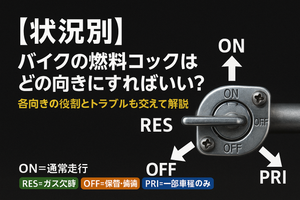
[By Situation] Which Way Should You Point Your Motorcycle's Fuel Cock? Explaining Each Position's Role and Potential Issues

Which way should a motorcycle's fuel tap be turned?

Source: https://pixabay.com/ja/photos/A4-1795712/
A motorcycle's fuel tap is a mechanism located in the passage that sends gasoline from the fuel tank to the carburetor. For normal riding, the "ON" position is fine.
Generally, in addition to "ON" and "OFF," fuel taps also have a "RES" position (and some models also have "PRI"). The position of the fuel tap allows you to send or cut off gasoline to the carburetor.
① For everyday riding: → "ON" position
For everyday riding, the fuel tap should generally be in the "ON" position (set so that the tip of the fuel tap lever points to "ON"). When it's in this position, gasoline flows from the fuel tank to the carburetor.
You can ride with the fuel tap in the ON position from a full tank until it's almost empty. When the fuel level gets low or you're about to run out of gas, change the tap lever to the "RES" position.
If you're riding with the fuel tap in the ON position and the engine doesn't rev smoothly when you open the throttle, it indicates you're running low on fuel (or about to run out), so switch to RES (Reserve).
② When you're almost out of gas: → "RES" position
If you're riding normally and the engine doesn't rev up when you open the throttle, or if the engine seems like it's about to stall, change the fuel tap lever to the "RES" (Reserve) position.
RES refers to a reserve tank. It's a function to use reserve gasoline when the fuel level is low. Switching the lever to "RES" allows you to use the remaining fuel (reserve).
After switching to RES, refuel as soon as possible, and don't forget to immediately return the tap lever to ON after refueling.
③ For long-term storage, maintenance, or when parking a carbureted bike: → "OFF" position
If you won't be riding your motorcycle for an extended period, or if you need to remove the fuel tank for maintenance or repairs, turn the fuel tap to "OFF."
When the tap is OFF, it cuts off the flow of gasoline from the tank, preventing gasoline from accumulating in the carburetor and avoiding gasoline leaks such as overflow. It is also effective in preventing gasoline odors.
If you ride your motorcycle daily, it's not necessary to turn it OFF. However, if you ride less frequently, such as only on weekends, turn the fuel tap lever to OFF after parking the motorcycle and remember to turn it back to ON before riding. (If left in OFF, the engine will stall within a few minutes.)
④ When fuel isn't reaching the carb: → "PRI" position (for some models only)
If the carburetor is dry after long-term storage or running out of gas, fuel may not flow even if the tap is in the ON position. In such cases, setting it to "PRI" will force gasoline to flow into the carburetor.
After setting the fuel tap to the PRI position, return it to the ON position after 1-2 minutes. If you continue riding with it in PRI, it can cause an overflow due to excessive fuel supply, so remember to return the fuel tap to ON after using PRI.
Not all models are equipped with PRI; some motorcycles do not have it.
Points to note
When riding a motorcycle, the fuel tap should primarily be in the ON position. If you experience fuel shortage symptoms, switch it to RES, but remember to return it to ON after refueling.
If you forget to return it to ON, you won't be able to use the reserve tank, and when you run out of gas, you'll be stranded.
Also, if you ride with the tap in the OFF position, the engine will stall, so remember to return it to ON before riding. And if you use PRI, don't forget to return it to ON, as not doing so can cause fuel leakage.
Roles of each fuel tap position

Source: https://pixabay.com/ja/photos/85-6703378/
The roles of the fuel tap positions on a gasoline tank are as follows:
| Fuel Tap Position | When to Use | Points to Note |
| ON | From a full tank until almost empty | Always ON while riding |
| OFF | When not riding for a long period, when removing the fuel tank | Engine will stop if you ride with it OFF |
| RES (Reserve) | When symptoms of running out of gas appear, or when you run out of gas | Always return to ON after refueling (do not leave in RES) |
| PRI (Primary) | When the carburetor runs out of gas (e.g., when out of fuel) | Return to ON 1-2 minutes after use (do not leave in PRI) |
Let's take a closer look at what each fuel tap position does and points to note when using them.
ON
When the fuel tap is in the ON position, gasoline flows into the carburetor, and ON is the default setting while riding.
You can ride with it in ON from a full tank until it's almost empty, but if you usually refuel early, you don't need to operate the tap position.
If you're riding in ON and experience symptoms of running out of gas, such as the engine not revving properly when you open the throttle, switch the fuel tap to the RES position.
OFF
When the fuel tap is in the OFF position, the flow of gasoline to the carburetor is cut off. This is used when you won't be riding the motorcycle for a long period or when removing the fuel tank for maintenance.
If you don't turn the tap to OFF when not riding for a long time, gasoline can flow into the carburetor and exceed its holding capacity, leading to "overflow" and leakage.
Also, if you don't turn it OFF when removing the fuel tank, gasoline will continuously flow out. So, if you're not riding for a long time or are removing the fuel tank, remember to turn the tap to OFF.
RES (Reserve)
RES (short for Reserve) is the fuel tap position to use when the fuel level becomes low while riding in ON, or when you experience symptoms of running out of gas (e.g., engine not revving smoothly when opening the throttle).
RES is sometimes called a reserve tank, but it doesn't mean there's a separate reserve tank. Instead, it draws gasoline from the bottom of the fuel tank that couldn't be drawn in the ON position.
It's a kind of insurance function that allows you to ride to a gas station when you experience fuel shortage symptoms in ON. Therefore, you need to refuel as soon as possible after switching to it, and don't forget to return the fuel tap to the ON position after refueling.
What is the fuel capacity of RES?
The fuel capacity of RES varies depending on the motorcycle, so the possible riding distance also changes by motorcycle. However, generally, the capacity of the reserve tank is about 2-4 liters.
For reference, the YAMAHA SR400 has a reserve tank capacity of 2.2L, and the Dragstar 1100 has a reserve tank of 4.5L, but the average reserve tank is around 2L.
Some motorcycles, such as 2-stroke bikes, may have a smaller reserve tank capacity, and some bikes may not even have RES. It's reassuring to know in advance whether RES is equipped and the capacity of the reserve tank and its possible riding distance.
PRI (Primary) *Some models only
PRI (Primary) is a function that forcibly sends gasoline to the carburetor and is only equipped on some models.
It is used when the gasoline in the carburetor is completely depleted, such as after completely running out of gas or after carburetor maintenance, but it is rarely used in daily operation.
PRI is a function to forcibly send gasoline to the carburetor, so if you don't return it to ON after 1-2 minutes, it can cause gasoline leakage (overflow) due to excessive fuel supply. Therefore, remember to return it after use.
Common fuel tap related problems

Source: https://pixabay.com/ja/photos/A9-2186589/
I've compiled a list of common fuel tap-related problems, along with their causes and solutions.
It's helpful to know these things in advance to avoid trouble or react calmly if a problem occurs, so please refer to this if you ride or plan to ride a carbureted motorcycle.
Engine won't start / stops immediately
If your motorcycle engine won't start or starts and then immediately stops, the fuel tap may be in the OFF position.
Also, clogs or deterioration within the fuel tap or fuel filter can impede gasoline flow, leading to problems like the engine failing to start or not revving properly.
If the engine won't start or stops immediately after starting, check if the fuel tap is in the OFF position. If it's in ON, check if the fuel tap is clogged.
Engine suddenly stalled while riding
If your engine stalls while riding, check if the fuel tap is in the OFF position or if you have enough gasoline.
If the fuel tap is OFF, the gasoline supply to the carburetor is cut off, so even if you can ride for a bit, the engine will quickly stall.
If you keep riding in the ON position, you'll eventually run out of gasoline, and the engine will stall unless you switch the fuel tap to RES (Reserve). So, if you experience fuel shortage symptoms, remember to switch to RES and refuel as soon as possible.
Tap is too stiff to turn / too loose
If the fuel tap is stiff and won't turn, it's likely due to lack of grease, aging deterioration, or rust seizing it up. Try applying grease or rust remover to remove the rust and dirt.
Conversely, if it's too loose, the fuel tap's fastening might be loose, so check the fuel tap and tighten it.
If the dirt, deformation, or rust due to aging deterioration is severe and it's seized, you'll need to replace the fuel tap. Depending on the model, the replacement cost is around 5,000 yen or more.
Gasoline is leaking
If gasoline is leaking from around the fuel tap or carburetor, first check if the fuel tap is in the PRI position (only on equipped motorcycles). If it's not in PRI, then a malfunction of the fuel tap is suspected.
Since PRI is a function that forcibly sends gasoline to the carburetor, leaving it in PRI can cause gasoline to leak from the carburetor (overflow). So, if your motorcycle has PRI, check the tap's position.
Also, gasoline leaks from around the fuel tap can be caused by various factors, such as deteriorated seals, damaged O-rings, or poor connection or damage to the fuel hose.
O-ring troubles
Behind the fuel tap lever is a rubber ring called an O-ring. When the O-ring is pressed, it blocks the gasoline pathway.
If the O-ring is damaged, such as with cracks, gasoline may leak from the damaged area, and it needs to be replaced with a new one.
The cost of an O-ring part is around a few hundred yen, but replacing it requires disassembling the fuel tap. If you ask a motorcycle shop to repair it, the cost will be around 3,000 to 5,000 yen.
Hose-related problems
Gasoline leaks can occur due to poor connections of hoses connected to the fuel tap or carburetor, or due to deterioration such as cracks.
If the connection is not secure, reconnecting it will fix the gasoline leak. However, if it's damaged, replacement is necessary, and the replacement cost is around 5,000 yen.
Recommended Products
Latest Articles



Popular product


×
![]()