One of the things that troubles beginner campers is choosing a tent.
A tent serves as your base and accommodation during camping, and since it's also expensive, people tend to be very cautious when choosing one. This time, we'll explain the key points for choosing a tent, which is a common source of worry for beginner campers.
Reasons why choosing a tent is difficult for beginnersIn recent years, camping has become common not only in summer but also in winter, so a wide variety of tents are available from many manufacturers. This makes it difficult to choose the optimal tent for yourself. Also, if you don't choose a size that matches the number of people participating in the camp, you might end up having one person sleep in the car. Additionally, if the assembly method is complicated, you'll have to expend a lot of effort for setup.
Therefore, people considering buying their first tent need to check at least the "number of people who can fit in the tent" and the "setup method" when choosing.
Since the tent setup method varies greatly depending on the tent type, you also need to understand beforehand what types of tents are available.
From here, we will introduce in more detail the number of people who can fit in a tent, the types of tents, and tents for each season, such as summer and winter.
Key points for choosing a tent that beginners should know
As mentioned earlier, the following three points are key for beginner campers choosing a tent:
- [1. Tent Type]
- [2. For how many people is the tent?]
- [3. Is it a 4-season tent?]
- [Summary]
Let's look at each in detail.
[1. Tent Type]
There are various types of tents. Here, we'll introduce types recommended for beginners that are relatively easy to set up.
Pop-up type
Pop-up tents have their frames pre-assembled, so you can set them up by simply opening them like an umbrella.
As the name suggests, they can be set up with a single touch and are self-standing, so there's no need to hammer pegs (tools to secure the tent to the ground) into the ground.
Therefore, pop-up tents are recommended for people with little setup experience or those who find setup troublesome.
Disadvantages include the difficulty of repair if they break and their inability to be stored compactly. While pop-up tents are recommended as an introduction to camping, those who want to seriously enjoy camping might consider other types of tents at some point.
Dome type
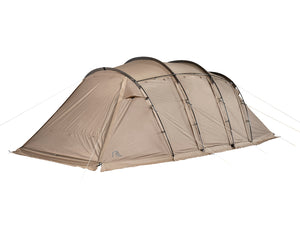
The dome type can be called the basic form of a tent. Dome tents are assembled by crossing multiple poles, making them resistant to strong winds. Also, dome tents can be set up with simple tools such as the "tent body," "poles," and "pegs," which is an advantage as even camping beginners and women can set them up without getting lost.
Dome types come in a rich variety, from single-person sizes to family sizes for 4 to 6 people. With a dome tent, you're sure to find the perfect tent for you.
Tipi type
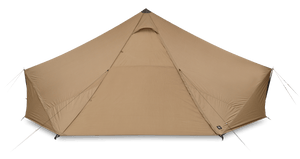
The tipi type is a tent characterized by its conical silhouette. The design of the tipi type is inspired by the portable dwellings of Native Americans.
It has a simple setup method: you set up a pole in the center of the tent and secure the perimeter with pegs. Its cute appearance makes it a popular type of tent among women and children.
However, a disadvantage of tipi tents is that they require pegging for fixation, which limits setup locations. Also, since a single pole supports the tent, it can be weak against strong winds.
If you are considering purchasing a tipi tent, you will need to consider wind strength on the day of your camp.
[2. For how many people is the tent?]
The second point for choosing a tent is to check how many people the tent is for.
Even for the same type of tent, sizes vary, with single-person tents and 6-person tents available, so consider the number of camp participants when purchasing.
Also, if you want extra space, choose a size with a capacity for 1 to 2 more people than you need. For example, if a family (2 adults, 2 children) uses one tent, a 5 to 6-person tent would provide a comfortable space.
[2. Is it a 4-season tent?]
Various tents are sold, such as summer tents and winter tents, tailored to the region and season of use. Summer tents generally excel in breathability and waterproofness, while winter tents specialize in insulation.
However, for first-time tent buyers, comparing tent features like breathability and insulation can be very difficult. They might end up choosing a tent unsuitable for the season.
Therefore, beginners are recommended to choose a 4-season tent that can be used in all seasons. 4-season tents have ventilation adjustments while also providing excellent insulation, making them suitable for use in various temperatures.
[Summary]
We've introduced how to choose a tent for beginner campers.
There are various types of tents, but for first-timers, it's recommended to choose based on these three points: "tent type," "how many people it's for," and "whether it's a 4-season type."
Get a tent that suits you and have a fun camping trip!