



Oct 5, 2026
中古バイクパーツを買うメリット・デメリット
The Appeal of Three-Wheeled Motorcycles and Trikes: From License Requirements to Recommended Models
What is a Trike?

Source: https://www.yamaha-motor.co.jp/mc/lineup/niken/color.html
A trike is a "three-wheeled motorcycle" or "three-wheeled bicycle" that can be ridden without a helmet. Since it has three wheels, its official name is Tricycle, which is abbreviated to trike.
Why is it that you don't need a helmet to ride a trike, even though your body is exposed like on a motorcycle?
Reasons why helmets are not required for trikes
Trikes maintain a stable, horizontal position with three wheels at all times, making them less prone to tipping over than two-wheeled motorcycles, so helmet use is not mandatory.
They can turn corners without leaning the vehicle like a motorcycle, and their three-wheel contact provides high stability.
For these reasons, under the Road Traffic Act, trikes are considered to have a low risk of tipping over, so helmets are not mandatory when riding them.
However, while it is "not legally mandated," helmet use is not prohibited and can be worn voluntarily.
Since trikes do not have a body like a passenger car, there is a possibility of head injury in the event of an accident.
Therefore, it is advisable to wear a helmet when riding a trike.
Trikes are broadly classified into three types based on their front and rear wheel configurations and driving characteristics.
Trike
There are three main types of trikes: "trike," "reverse trike," and "leaning trike."
A basic "trike" is a trike with one front wheel, two rear wheels, and rear-wheel drive.
A regular driver's license is required to operate it, and trikes that do not require gear shifting like scooters can be driven with an automatic-only regular driver's license. (They cannot be driven with a motorcycle license.)
The legal speed limit for a "three-wheeled vehicle" is 60 km/h on ordinary roads and 80 km/h on expressways. Therefore, driving at the same speed as a passenger car will result in speeding, so caution is required.
Many models are customized into trikes based on commercially available scooters and motorcycles, allowing for personalization.
Trike vehicle inspection and parking
Vehicle inspection classification is the same as for motorcycles: those with sidecar light two-wheelers (50cc to under 250cc) do not require inspection, while trikes exceeding 250cc are classified as "motorcycles with sidecars" and require inspection.
Automobile tax, weight tax (only at initial registration), compulsory automobile liability insurance, and voluntary insurance are also treated the same as for motorcycles, and a parking certificate is not required.
In parking lots, trikes occupy one space, similar to passenger cars, and in the event of a parking violation, the same fines and point additions apply as for passenger cars.
Required licenses for "trikes"
• Required license: Regular driver's license or higher (cannot be driven with a motorcycle license)
• Helmet use: Optional
• Vehicle inspection: Required if displacement exceeds 250cc
• Parking certificate: Not required
Reverse Trike
A reverse trike is a trike with two front wheels and one rear wheel, primarily with rear-wheel drive.
It is called a reverse trike because its wheel configuration is the opposite (reverse) of a trike with one front wheel and two rear wheels.
Other than the wheel arrangement, it is the same as a trike: it can be ridden with a regular driver's license regardless of displacement, and helmet use is optional (though recommended).
Required licenses for "Reverse Trikes"
• Required license: Regular driver's license or higher (cannot be driven with a motorcycle license)
• Helmet use: Optional
• Vehicle inspection: Required if displacement exceeds 250cc
• Parking certificate: Not required
Leaning Trike
A leaning trike is a trike that leans (tilts) its body when turning, and its classification is different from other trikes; it is considered a "three-wheeled motorcycle."
Structurally, there are leaning trikes with either trike or reverse trike configurations, and any trike that can lean with three wheels is a leaning trike.
Since leaning trikes lean their bodies like motorcycles when turning, there is a risk of falling, so helmets are required.
As they are classified as three-wheeled motorcycles, a motorcycle license is required to operate them, which also differentiates them from trikes that can be driven with a regular driver's license.
Required licenses for "Leaning Trikes"
• Required license: Motorcycle license (cannot be driven with a regular driver's license)
• Helmet use: Required
• Vehicle inspection: Required if displacement exceeds 250cc
• Parking certificate: Not required
What is the difference between a three-wheeled motorcycle and a trike?
The differences between a three-wheeled motorcycle and a trike are the presence or absence of a helmet wearing obligation, the required driver's license, and the turning method.
For a trike, helmet use is optional, and it can be driven with a regular driver's license regardless of its displacement.
In contrast, a three-wheeled motorcycle requires a helmet and a motorcycle license appropriate for its displacement. (It cannot be driven with a regular driver's license.)
Also, a trike turns by steering the handlebars, whereas a three-wheeled motorcycle leans its body and turns like a motorcycle.
Comparison of Trikes and Three-wheeled Motorcycles
| Vehicle Classification | Three-wheeled Motorcycle | Trike, Reverse Trike |
| Required License | Motorcycle License | Regular Driver's License |
| Helmet Use | Required | Optional (Recommended) |
| Wheel Width (Tread) | Less than 460mm | |
| Legal Speed Limit | Ordinary roads: 60 km/h, Expressways: 100 km/h | Ordinary roads: 60 km/h, Expressways: 80 km/h |
| Vehicle Inspection | Required for displacement over 250cc | |
Both three-wheeled motorcycles and trikes have a legal speed limit of 60 km/h on ordinary roads, but on expressways, trikes have a speed limit of 80 km/h, while three-wheeled motorcycles have a speed limit of 100 km/h.
What kind of driver's license is required for three-wheeled motorcycles and trikes?
Three-wheeled motorcycles and trikes require different licenses because they belong to different vehicle categories.
Trikes can be driven with a regular driver's license
Trikes can be driven with a regular driver's license, regardless of displacement.
If you have a regular driver's license, you can drive a 125cc trike or a 750cc trike.
A motorcycle license is required to operate a three-wheeled motorcycle.
Three-wheeled motorcycles are classified as motorcycles, so the required license for operation is a motorcycle license appropriate for the displacement.
For a 250cc three-wheeled motorcycle, a regular motorcycle license is required; for a 500cc three-wheeled motorcycle, a large motorcycle license is required.
Advantages of three-wheeled motorcycles and trikes
Three-wheeled motorcycles and trikes are positioned between motorcycles and passenger cars, often said to offer the best of both worlds.
What exactly are their advantages?
No worries about tipping over with three wheels
One advantage of three-wheeled motorcycles and trikes is that they don't tip over when stationary.
Unlike two-wheeled motorcycles that fall without support, they are always supported by three wheels, maintaining a stable posture.
This high stability means there's no need to worry about tipping over like on a two-wheeled motorcycle, offering peace of mind even for smaller individuals who may lack confidence in their physical strength.
Excellent seating comfort
Trikes do not require the rider to put their feet on the ground when stopped, so the riding posture is always maintained.
Since the seat doesn't need to consider foot reach, many models feature thick, wide seats, providing excellent riding comfort.
In the case of two-wheeled motorcycles, depending on foot reach when stopped, the seat may be "scooped out" (thickness reduced), sacrificing comfort.
On the other hand, with trikes, you don't have to worry about foot reach, so you can prioritize comfort and choose a seat without concerns about its thickness.
Plenty of carrying capacity
Many trike models also have ample luggage space, making them excellent for carrying capacity.
Most models feature a carrier space behind the passenger seat to load items like top cases or bags.
Some models even have a luggage compartment at the very rear, which can easily accommodate luggage for a 2-3 day touring trip.
Disadvantages of three-wheeled motorcycles and trikes

Source: https://www.yamaha-motor.co.jp/mc/lineup/niken/feature.html#a2
Now that we've covered the advantages of three-wheeled motorcycles and trikes, let's discuss their disadvantages.
Difficult to maneuver
Three-wheeled motorcycles and trikes are heavier and wider than two-wheeled motorcycles, making them difficult to maneuver until you get used to them.
Some models have a reverse gear, but pushing them may result in your foot being run over by the rear wheel, requiring different maneuvering skills than a two-wheeled vehicle.
Parking problems
Parking requires a space similar to that of a regular car, which can sometimes be difficult to secure.
Since their appearance is similar to motorcycles, you might encounter difficulties with parking at touring destinations or monthly parking lots, where you may not be allowed to park in a regular car space.
Not very strong in curves
Trikes, which turn by steering the handlebars, can experience understeer, similar to passenger cars, if they attempt to corner at excessive speed.
Understeer is a condition where the vehicle drifts outward relative to the amount of steering input, and it can be dangerous as it may lead to lane departure or crossing into oncoming traffic.
Understeer occurs when the tire's grip limit is exceeded, and it is more likely to happen with heavier vehicles.
Especially when riding heavy, large-displacement trikes, it is necessary to reduce speed when cornering.
Solving your questions about three-wheeled motorcycles and trikes!
Here, we address "frequently asked questions" about three-wheeled motorcycles and trikes, along with their answers.
Is helmet use mandatory?
Helmet use is not mandatory for trikes or reverse trikes, but it is required for three-wheeled motorcycles.
What about parking?
In parking lots, you can use the same parking spaces as regular passenger cars.
Conversely, if you park in a bicycle parking area, you would be taking up space meant for other motorcycles and bicycles, so it's important to park in a passenger car space.
Is a vehicle inspection required?
Both trikes and three-wheeled motorcycles require a vehicle inspection if their engine displacement exceeds 250cc.
If it is less than 250cc, a vehicle inspection is not necessary.
What are the running costs?
The running costs vary depending on the engine displacement because vehicle inspections may or may not be required.
As a guideline, the running costs are comparable to those of a two-wheeled motorcycle with the same engine displacement.
| Displacement | 125cc to under 250cc | Over 250cc |
| Weight Tax | 4,900 yen (only at registration) | 3,800 yen / 2 years (per inspection) |
| Automobile Tax | 3,600 yen / year | 6,000 yen / year |
| Compulsory Insurance | 7,540 yen / 12 months | 9,440 yen / 25 months |
| Vehicle Inspection | Not required | Required |
| Voluntary Insurance | Same as 2-wheeled motorcycles | |
In addition to these statutory expenses, you will need to cover fuel costs, parking fees, and maintenance costs such as oil changes and tire replacements.
Fuel efficiency varies greatly depending on the model and riding style, so exact figures cannot be calculated, but it's a good idea to estimate around 80% of the base motorcycle's efficiency.
What about voluntary insurance?
Voluntary insurance is treated the same as for two-wheeled motorcycles.
What should I pay attention to in terms of maintenance?
Trikes with a displacement of 250cc or more undergo a vehicle inspection every two years, so they are serviced accordingly, but those under 250cc must perform their own maintenance.
In addition to oil changes and tire wear checks, trikes also have differential oil, which two-wheeled motorcycles do not.
The differential is a mechanism that distributes driving force to the left and right wheels, and like engine oil, it requires regular oil changes.
What happens if I commit a violation?
Since trikes can be ridden with a regular driver's license, they are treated the same as regular passenger cars in terms of license classification.
Violations are subject to the same fines and point deductions as regular passenger cars.
Particularly noteworthy violations are the speed limit on expressways (80 km/h) and parking violations.
The speed limit for two-wheeled motorcycles on expressways is 100 km/h, so if you're touring with a two-wheeled motorcycle and drive at its speed, you'll be committing a violation.
Also, since parking spaces are different, there have been cases where trikes received parking tickets even though they parked in the same way as two-wheeled motorcycles, so caution is necessary.
【By Displacement】11 Recommended Trikes You Can Ride with a Regular License!
We'll introduce 10 recommended trikes that can be ridden with a regular driver's license.
Also, for those who want a three-wheeled motorcycle that can be ridden with a motorcycle license, we'll start with Yamaha's Tricity 125, which was a pioneer of three-wheeled motorcycles that ride like motorcycles.
We'll be introducing models ranging from 125cc to large models exceeding 1,800cc, so find a model that interests you and check it out.
【125cc】Yamaha Tricity

Source: https://www.yamaha-motor.co.jp/mc/lineup/tricity/spec.html
The Yamaha Tricity is a leaning trike with two front wheels and one rear wheel, of the scooter type.
With a displacement of 125cc, it is classified as a "light motorcycle," requiring a motorcycle license for small automatic two-wheelers or higher for operation.
It features Yamaha's proprietary "LMW (Leaning Multi-Wheel)" system, where the two front wheels independently dampen in response to road irregularities.
• Manufacturer: Yamaha Tricity 125
• Length x Width x Height: 1,980 x 750 x 1,210 (mm)
• Vehicle Weight: 164kg
• Required License: Small Automatic Motorcycle License
• Sales Price (tax included): 462,000 yen (ABS)
【125cc】APtrikes125 (with roof)
The APtrikes125 is a roofed trike with an appearance similar to a tuk-tuk, which is also used as a taxi in Thailand.
It is equipped with an air-cooled 4-stroke single-cylinder engine, with a maximum output of 8.72ps and a top speed of 70Km/h (manufacturer recommends up to 50Km/h).
The transmission is a 4-speed return type, so a regular manual driver's license is required for operation.
The APtrikes125 is produced by a Chinese motorcycle manufacturer and sold by Alive Plus, headquartered in Hyogo Prefecture.
• APtrikes125
• Length x Width x Height: 2,200 x 1,000 x 1,650 (mm)
• Vehicle Weight: 232Kg
• Sales Price (tax included): 432,300 yen
【200cc】Majesty Trike
The "Majesty Trike" is a trike based on the "Yamaha Majesty" maxi-scooter.
The Majesty was originally popular as a base vehicle for customization due to its ease of modification.
The Majesty Trike transforms beyond a two-wheeled vehicle into a trike.
• Majesty Trike
• Overall length x overall width x overall height: Varies depending on customization
• Vehicle weight: Varies depending on customization
• Sales price (tax included): Approximately 300,000 yen and up
【200cc】Trike 200 HL200XR

Source: https://item.rakuten.co.jp/icebear/hl200x-kit-r/
The Trike 200 HL200XR is a stylish trike with chrome parts placed throughout.
While lowered, ride comfort is prioritized, and measures to reduce vibration are incorporated.
The front lights, tail lights, and turn signals are all LED, ensuring excellent visibility.
• Trike 200 HL200XR
• Overall length x overall width x overall height: 2,400 x 1,150 x 1,200 (mm)
• Vehicle weight: 180 kg
• Sales price: 415,800 yen
【250cc】Piaggio MP3
The Piaggio MP3 is a trike produced and sold by Piaggio, an Italian manufacturer of motorcycles and automobiles.
The MP3 line-up consists of nine models with different displacements and specifications, ranging from 125cc to 500cc.
The 250cc category includes three types: the 12-inch MP3 250RL, the 250FL with 14-inch rear wheels, and the 250LT with a wider tread of 465mm.
• Piaggio MP3
• Overall length x overall width x overall height: 2,140 x 760 x 1,490 (mm)
• Vehicle weight: 215 kg
• Sales price (tax included): 965,000 yen
【530cc】GORDON TMAX 530 Trike

Source: https://gordon.co.jp/product/gordon-
The GORDON TMAX 530 is a trike based on Yamaha's maxi-scooter "TMAX 530."
Customized into a trike by GORDON, a trike manufacturer headquartered in Gunma Prefecture, it features a robust design.
The trike balances comfort and sportiness, incorporating a lightweight dedicated frame and an aerodynamic design to bring out the best features of the TMAX 530.
• GORDON TMAX 530
• Overall length x overall width x overall height: 2,200 x 1,450 x 1,250 (mm)
• Vehicle weight: Varies depending on customization
• Used sales price: From 4.5 million yen
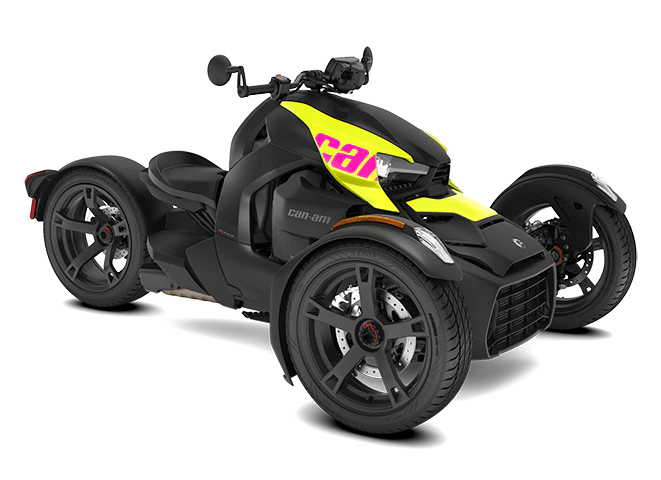
【600cc】Can-Am Ryker

Source: https://can-am.brp.com/on-road/jp/ja/models/ryker.html#ryker
The Can-Am Ryker 600 is a trike that can be enjoyed both on and off-road.
Engine options include 600cc and 900cc, with the 600cc model equipped with a two-cylinder engine producing a maximum output of 50 hp and maximum torque of 49.7 Nm.
In addition to a wide range of color variations, the ergonomic features allow for approximately 100,000 customization possibilities.
• Can-Am Ryker 600cc
• Overall length x overall width x overall height: 2,352 x 1,522 x 1,063 (mm)
• Vehicle weight: 270 kg
• Sales price (tax included): From 1,543,300 yen
【900cc】Can-Am Ryker

Source: https://can-am.brp.com/on-road/jp/ja/models/ryker.html#ryker
The 900cc version of the Can-Am Ryker is equipped with a powerful three-cylinder engine producing a maximum output of 82 hp and maximum torque of 79.1 Nm.
It features an "Eco Mode" for improved fuel efficiency and a "Sport Mode" for enjoying drifting on paved roads.
Compared to the 600cc model, engine output and torque are significantly higher, while the vehicle weight only increases by 10kg, making it ideal for those who want a more sporty ride.
• Can-Am Ryker 900cc
• Overall length x overall width x overall height: 2,352 x 1,522 x 1,060 (mm)
• Vehicle weight: 280 kg
• Sales price (tax included): From 1,543,300 yen
【1330cc】Can-Am Spyder F3

Source: https://can-am.brp.com/on-road/us/en/models/spyder-f3.html#spyder-f3
The "Can-Am Spyder F3" is a sporty cruising trike.
Based on a Y-shaped frame structure with a low center of gravity, it offers a gripping sensation as if clinging to the road, thanks to its electronically controlled suspension.
With four handlebar options (including accessories) and five adjustable footpeg positions, this model can be flexibly customized to suit the rider.
• Can-Am Spyder F3
• Overall length x overall width x overall height: 2,642 x 1,497 x 1,099 (mm)
• Vehicle weight: 199 kg
• Sales price (tax included): From 2.4 million yen (varies depending on exchange rate)
【1832cc】Trikes F6T

Source: http://www.trikes.co.jp/#overview
The Trikes F6T is a luxurious trike based on HONDA's flagship model, the "GOLD WING."
It maintains the elegant beauty of the GOLD WING while seamlessly integrating into a cohesive design.
There are two grades: the base grade and the Luxury grade, which includes grip heaters, HID headlights, and a long screen. (Luxury: 5,464,800 yen)
• Trikes F6T (Base Grade)
• Overall length x overall width x overall height: 2,995 x 1,470 x 1,250 (mm)
• Vehicle weight: -
• Sales price (tax included): 5,130,000 yen
【1868cc】Harley-Davidson Tri Glide Ultra

Source: https://www.harley-davidson.com/jp/ja/motorcycles/tri-glide-ultra.html
The "Tri Glide Ultra" is a trike released by Harley-Davidson, the icon of American motorcycles.
Harley-Davidson created the trike itself, which appeared in 1932 as a cargo vehicle, and its use expanded from daily commuting to leisure and touring.
The Tri Glide Ultra, equipped with a 1,868cc V-twin engine, offers the distinctive vibration and roaring pulse characteristic of a Harley.
• Tri Glide Ultra
• Overall length x overall width x overall height (mm): 2,670 x 1,390 x 1,430
• Vehicle weight: 564 kg
• Sales price (tax included): From 5,039,100 yen
Are there trikes that can carry 3 or 4 people?!
Yes, there are trikes that can seat three people, and one example is the AP TRIKES125.
The AP TRIKES125 is a covered trike with seating for two passengers in the rear, allowing for a total of three people including the driver.
It also has a reverse gear, making it relatively easy to maneuver, but as it's a 125cc vehicle, it might feel a bit underpowered with three passengers.
While it is legally permitted on expressways, the importer/distributor, Alive Plus (Hyogo Prefecture), recommends using it only on regular roads due to engine power considerations.
Summary
#OfficialPicturesAndMyKidsSideBySide
Well, trikes do have an elegance to them (self-praise)😅 pic.twitter.com/ATCqq0QU0t
— Japan Water Graffiti Association。シルバーアートちょちょ (@matsuri_0619) June 23, 2022
We've provided an overview of trikes, explaining different types and recommending some models.
Trikes, which are neither motorcycles nor passenger cars, but combine the best of both, offer a unique riding experience.
Since trikes and reverse trikes can be ridden with a regular driver's license, more people can operate them compared to motorcycles, which require a two-wheel license.
While there's less risk of falling compared to motorcycles, and helmets are not mandatory, your body is always exposed. Therefore, it's safer to wear a helmet in case of an unforeseen event while riding.
Maintenance costs are comparable to motorcycles of the same displacement, meaning they don't require as much expense as passenger cars. This is another advantage of trikes, so if you're interested, be sure to check them out.
Recommended Products
Latest Articles
-

-
 Sep 13, 2026絶版・旧車パーツがプレミア価格になる理由と相場の調べ方を徹底解説
 -
 Sep 13, 2026夏のバイクの服装は?暑さをしのぎながら、安全性も確保できる服まとめ
 -
 Sep 13, 2026【ジャンク品売れる?】バイクパーツや部品は壊れている・サビている・欠品ありでも売却可能か
 -
 Sep 13, 2026カワサキの純正部品が買えなくなるって本当?理由と今後の代替手段、まだ買えるショップを解説
 -
 Sep 13, 2026バイクパーツ(部品)買取の相場は?業者比較や売却価格が左右される5つの要素
 -

-

-
-


Popular product


×
![]()