Among fishing rods, "eging rods" are popular, but with so many types available, it's hard to know which one to choose.
Some are for beginners, while others are for advanced users, so if you don't choose carefully, you might end up with one that doesn't match your skill level.
This time, we will introduce the essential points for choosing an eging rod.
Table of Contents
- [1. What is an Eging Rod?]
- [2. What Beginners to Advanced Anglers Should Know]
- [3. Leader Selection is Also Important]
- [4. Conclusion]
[1. What is an Eging Rod?]
What kind of fishing rod is an eging rod, exactly? Let's explain that in detail first.
First, the "egi" in eging refers to a tool that was used in ancient times to target large squid. Even today, as a remnant of that, the method of fishing for squid is called eging.
In other words, eging rods were originally made to be "rods for catching squid." However, many of today's eging rods are versatile types that can be used not only for squid but also for catching fish such as horse mackerel and amberjack.
By the way, a characteristic of eging rods is that they are lightweight yet strong. Eging rods are mainly used to target Bigfin Reef Squid, and because the method of catching Bigfin Reef Squid requires frequent movement of the egi to make it look like real bait.
If the rod is frequently jerked, it naturally requires physical exertion, so a lightweight rod is preferred.
[2. What Beginners to Advanced Anglers Should Know]
There are hundreds of types of eging rods on the market, so finding the optimal one for you can be a challenge.
From here, we will introduce three key points for choosing an eging rod that everyone, from beginners to advanced anglers, should keep in mind.
Length
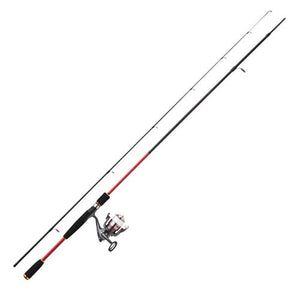
The first thing you should check when choosing an eging rod is its "length." Rods are generally expressed in units of feet (ft), and about 8.6 ft (approx. 2.6 m) is said to be the easiest to handle.
Of course, the longer the rod, the farther you can cast, allowing you to target fish further from the shore. However, longer rods are heavier, and will feel even heavier when held.
Beginners, in particular, are not used to handling rods, so it's appropriate to choose a rod around 8.6 ft without overreaching.
Hardness
Rods differ in strength depending on the materials used.
Hard rods tend to break when bent, but they have the advantage of transmitting the pulling force easily. Therefore, stiffer rods are suitable for advanced anglers and those targeting larger fish.
For beginners, a soft rod is best. Soft rods bend well, making them easy to cast. Rod hardness is indicated by letters of the alphabet, with UL (Ultra Light) being the softest, followed by L (Light), and ML (Medium Light).
For beginners, a rod with a strength indicated by M, from ML (Medium Light) to MH (Medium Hard), is recommended.
Weight
Finally, weight.
However, the weight of the rod is important for the overall balance with other equipment, such as the reel and lure attached to it. By the way, the overall weight of the rod is generally called "tackle balance."
Of course, the weight of the rod cannot be ignored when considering tackle balance. Since you might be holding the rod all day, it's generally safe to choose a lightweight one.
[3. Leader Selection is Also Important]
Choosing the leader, commonly referred to as fishing line, is also important.
Of course, you can't fish with just an eging rod alone, so the feel and usability will also change depending on the reel and line you combine with the rod.
Leaders can be classified into the following three types based on their material:
・Nylon line
・Fluorocarbon line
・PE line
Nylon lines are inexpensive but very brittle. For example, if you are considering purchasing an eging rod for catching Bigfin Reef Squid, nylon line is not recommended.
One method for catching Bigfin Reef Squid is called "zuri-biki," which involves sinking the lure to the bottom and dragging it. There is a risk of the line breaking if it rubs against the ground, so nylon line, which lacks durability, is not suitable.
For zuri-biki, durable fluorocarbon line is recommended.
Also, the way the leader and main line are tied, such as the FG knot and No-Name knot, can also affect the strength.
[4. Conclusion]
Eging rods are primarily used for catching squid, but their strength lies in their broad versatility, allowing them to be used for targeting various fish.
They are also very easy to handle rods, even for beginners who want to try different targets, making them highly recommended.
However, with so many types of eging rods available, choosing one can be a challenge. When selecting a rod, find the one that suits you best, focusing on length, weight, and hardness.
Furthermore, in addition to the rod, differences in leaders also significantly impact actual fishing.
Nylon line is recommended for those who want to save money, while fluorocarbon line is recommended for those who prioritize strength.