



Mar 30, 2026
[New Standards] Motorcycle Engine Displacement Categories: Maintenance Costs, Traffic Rules, and Licenses for Each Displacement
Average Fuel Economy of Motorcycles by Displacement! Explaining Characteristics of Fuel-Efficient Bikes and Tips for Improving Fuel Economy
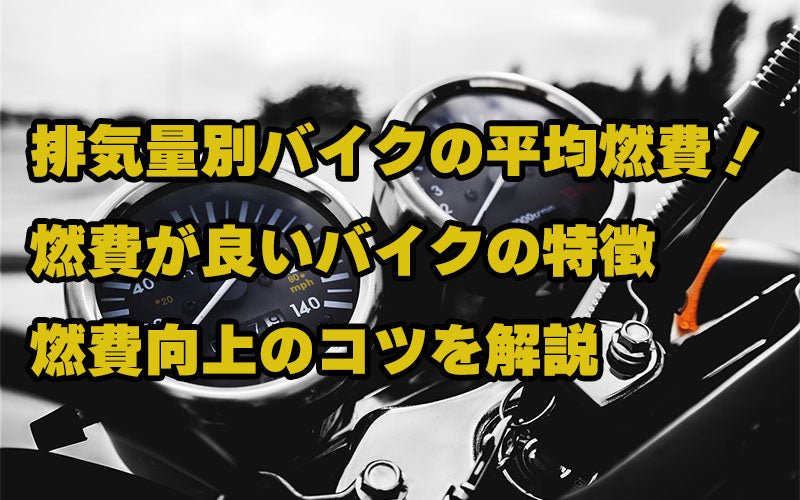
Average Fuel Economy of Motorcycles by Displacement

Source: https://pixabay.com/ja/photos/93-1839003/
While motorcycles generally have better fuel economy than cars, the average fuel economy for typical motorcycles, according to catalog values, is as follows:
Since actual fuel economy (fuel economy during actual riding) rarely matches the catalog values, it's a good idea to consider about 70% of the catalog value as a realistic benchmark.
| Motorcycle Class | Average Fuel Economy (WMTC Mode Value) |
| Class 1 Mopeds (50cc) | 50-60 Km/L |
| Class 2 Mopeds (125cc) | 40-45 km/L |
| 250cc Class | 25-30 km/L |
| 400cc Class | 20-25 km/L |
| Large Class (over 400cc) | 15-20 km/L |
Among these, Class 1 Mopeds (50cc) achieve 50-60 Km/L and Class 2 Mopeds (125cc) achieve 40-45 Km/L, which are outstanding compared to other classes.
As a reference, the WMTC mode value for the Prius, a representative hybrid passenger car, is 32.6 km/L, which is the same average fuel economy as the 250cc class.
Average Fuel Economy by Model
The average fuel economy by model for each class is as follows:
| Motorcycle Class | Model | Average Fuel Economy (WMTC Mode Value) |
| Class 1 Mopeds (50cc) | Super Cub 50 | 69.4 Km/L |
| Class 2 Mopeds (125cc) | MT-125 ABS | 49.4 km/L |
| 250cc Class | V-Strom 250 | 32.1 km/L |
| 400cc Class | Ninja 400 | 25.7 km/L |
| Large Class (over 400cc) | CB1300 SUPER FOUR | 17.2 km/L |
Although these are reference values as fuel economy varies depending on riding conditions and style, the Super Cub 50's 69.4 Km/L is an exceptionally excellent average fuel economy.
For reference, if actual fuel economy (fuel economy during actual riding) is about 70% of the catalog value, the Super Cub 50 would achieve 48.5 Km/L, and the large motorcycle CB1300 SUPER FOUR would get about 12 Km/L.
Characteristics of Fuel-Efficient Motorcycles

Source: https://pixabay.com/ja/photos/A1-8992548/
Fuel-efficient motorcycles generally have the following characteristics:
- Light body
- Fewer cylinders
- Small engine displacement
- 4-stroke engine
- Equipped with an idling stop function
If you are looking for a motorcycle with better fuel economy, try choosing one based on these characteristics.
Characteristic 1: Light Body
A lighter body requires less energy to move, thus consuming less fuel.
Mopeds have compact engines and bodies and are lightweight, requiring less fuel to operate compared to heavier classes of motorcycles, resulting in better fuel economy.
While factors like the number of engine cylinders also play a role, if you are looking for a motorcycle with even better fuel economy, it's advisable to choose one with a lighter body weight.
Characteristic 2: Fewer Cylinders
Fewer cylinders mean fewer parts are used and there is less loss in engine rotation, which improves fuel economy.
Additionally, engines with fewer cylinders achieve maximum torque at lower RPMs, allowing them to operate at lower rotational speeds, which helps keep the RPMs low.
While more cylinders result in smoother engine rotation, they also increase the number of contact points between parts, leading to greater frictional losses and generally worse fuel economy.
Characteristic 3: Small Engine Displacement
Motorcycles with small engine displacements consume less fuel for combustion compared to large displacement motorcycles, resulting in better fuel economy.
Additionally, smaller displacement engines are lighter in size and weight, fitting the description of lightweight motorcycles mentioned in Characteristic 1 for good fuel economy, and thus tend to be more fuel-efficient.
Because smaller displacement engines consume less fuel and tend to be lighter, small-displacement motorcycles generally have good fuel economy.
Characteristic 4: 4-Stroke Engine
Motorcycle engines come in 4-stroke and 2-stroke types, and for the same displacement, 4-stroke engines offer better fuel economy.
4-stroke engines are more combustion-efficient than 2-stroke engines, minimizing wasted energy and thus leading to a difference in fuel economy.
Due to exhaust gas regulations, 2-stroke motorcycles are no longer sold, but 2-stroke motorcycles also require oil in addition to fuel, meaning both fuel and oil costs are necessary for operation.
Characteristic 5: Equipped with an Idling Stop Function
With an idling stop function, the engine automatically stops when the vehicle halts, such as at a traffic light, preventing idling and thus reducing fuel consumption.
Even if the idling stop duration per stop is short, it accumulates over time to make a significant difference. The longer you ride in urban areas with frequent stop-and-go traffic, the greater the effect of idling stop in reducing fuel consumption.
However, restarting the engine requires fuel equivalent to 5 seconds of idling. If stops shorter than 5 seconds are repeated, it can paradoxically lead to higher fuel consumption.
Ways to Improve Motorcycle Fuel Economy

Source: https://pixabay.com/ja/photos/B3-7390983/
To improve motorcycle fuel economy, you need to perform maintenance and review your riding habits.
We will explain methods to improve motorcycle fuel economy. If you "feel your fuel economy has worsened lately" or "want to improve your motorcycle's fuel economy even more," keep the following points in mind.
Fuel Economy Improvement 1: Don't Neglect Regular Maintenance
Regular maintenance to keep your motorcycle in good condition can improve its fuel economy.
Maintenance items related to fuel economy include "checking tire pressure," "spark plugs," "air cleaner," and "regular engine oil changes."
Low tire pressure increases rolling resistance and reduces fuel economy, while degraded spark plugs can lead to incomplete combustion, reducing acceleration performance and engine starting ability.
A clogged air cleaner or degraded engine oil can also lead to decreased engine efficiency and worse fuel economy, so make sure to perform regular maintenance.
Fuel Economy Improvement 2: Pay Attention to Driving Operations
Sudden starts and rapid acceleration quickly consume fuel and lead to poor fuel economy.
Also, operating the throttle like an on-off switch consumes more fuel than necessary. The ideal is to gradually adjust the throttle opening and closing according to the driving conditions.
Avoid unnecessary idling and sudden throttle operations, and consciously make smooth throttle adjustments.
Fuel Economy Improvement 3: Reduce Unnecessary Luggage
Carrying a lot of luggage on a motorcycle increases its weight, requiring more energy for acceleration and leading to worse fuel economy.
Remove unnecessary items and minimize the amount of luggage carried to reduce weight as much as possible.
Three Types of Motorcycle Average Fuel Economy Measurement and Display Methods

Source: https://pixabay.com/ja/photos/A1-1283201/
The average fuel economy values for motorcycles are listed in catalogs, but in addition to the "fixed-speed fuel economy value" that has been used, the "WMTC mode value" has also been adopted.
There is also the actual fuel economy measured during real-world riding. We will explain the differences between each of these fuel economy values.
1. Fixed-Speed Fuel Economy Value
The "fixed-speed fuel economy value" is determined by measuring the average fuel economy while driving at a constant speed on a flat, paved road.
Since the fuel economy is measured by continuously driving on a flat road at a speed of 60 Km/h (30 Km/h for Class 1 Mopeds), it differs significantly from fuel economy on general roads, which involve uphill and downhill sections, starts and stops, and acceleration.
For this reason, in addition to the fixed-speed fuel economy value, the WMTC mode value has also been incorporated into motorcycle fuel economy figures.
2. WMTC Mode Value
The WMTC mode value is an international standard testing method that started in 2005, incorporating various patterns close to actual riding, such as starting, stopping, and accelerating.
It is measured from emitted exhaust gases, with the motorcycle running on a dynamometer (chassis dynamometer) and measurements taken during various driving patterns such as starting, stopping, and accelerating.
While the fixed-speed fuel economy value was previously used, as it differed significantly from actual driving conditions, the WMTC mode value has been adopted as the catalog's official value in recent years, making it closer to the actual fuel economy during real-world driving.
3. Actual Fuel Economy
Actual fuel economy is a value measured by motorcycle users during real-world riding, and it can be calculated by dividing the distance traveled by the amount of fuel consumed.
For example, if 20L of fuel is used to travel 400 Km, (distance traveled) 400 (Km) ÷ (fuel consumed) 20 (L) = 20, so the average fuel economy is 20 Km/L.
Since it's calculated based on actual driving, it provides a more accurate fuel economy value than the WMTC mode value, but it also varies depending on the rider's driving style.
FAQ on Motorcycle Average Fuel Economy

Source: https://pixabay.com/ja/photos/A4-1914420/
This section summarizes "frequently asked questions" and "answers" regarding the average fuel economy of motorcycles.
If you are concerned about motorcycle fuel economy or want to know about fuel-efficient motorcycles, please refer to this section.
I want to know how my motorcycle's fuel economy compares to the general average.
If you search for "manufacturer name and model name + average fuel economy" for your motorcycle, you will find catalog values like WMTC mode values and actual fuel economy reported by users.
By comparing the actual fuel economy found in your search with your motorcycle's fuel economy, you can see the difference from the general average, so please check it out.
However, data may not be available for all models. In such cases, compare your motorcycle's fuel economy to about 70% of the catalog value as a benchmark.
If your fuel economy is worse than the average, try implementing actions that improve fuel economy, such as checking tire pressure and spark plugs, or reviewing your riding habits.
What motorcycles have good average fuel economy?
Here are representative fuel-efficient motorcycles by displacement class:
| Motorcycle Class | Model | Average Fuel Economy (WMTC Mode Value) |
| Class 1 Mopeds (50cc) | Super Cub 50 | 69.4 Km/L |
| Class 2 Mopeds (125cc) | Monkey 125 | 68.7 km/L |
| 250cc Class | YZF-R15 | 50.2 km/L |
| 400cc Class | GB350/GB350S | 39.4 km/L |
| Large Class (over 400cc) | NC750X | 28.6 km/L |
The Honda Super Cub 50 has the best WMTC mode fuel economy at 69.4 Km/L, but the Honda Monkey 125 in the 125cc class also achieves an excellent WMTC mode value of 68.7 km/L, nearly matching the Super Cub 50.
If you're looking for a fuel-efficient motorcycle, it's a good idea to use the average fuel economy of these motorcycles as a reference when comparing and deciding on your candidates.
What is the most fuel-efficient RPM range?
The most fuel-efficient RPM range for motorcycles varies depending on the model and displacement, but it's generally around 2,500 rpm to 4,000 rpm, which translates to about 50 km/h on main roads (for Class 1 Mopeds, the speed limit is 30 km/h by road traffic law).
Conversely, driving habits that reduce fuel economy include revving the engine close to the red zone during acceleration, rapid acceleration, or sudden starts, or any "sudden" operation, so avoid these actions while driving.
Furthermore, when driving on highways, the key is to maintain a constant throttle opening and the same RPM, typically around 3,000 rpm to 4,500 rpm.
Summary

Source: https://pixabay.com/ja/photos/A1-431838/
We have explained the average fuel economy of motorcycles by displacement class, characteristics of fuel-efficient motorcycles, and introduced representative fuel-efficient models for each class.
Sudden operations like rapid acceleration and quick starts lead to worse fuel economy, and neglecting motorcycle maintenance can also impair acceleration performance and engine starting ability, thus reducing fuel economy. Therefore, regular maintenance is crucial.
While there are two types of fuel economy values published by motorcycle manufacturers, and they may not always match actual fuel economy, they can serve as a guide when choosing a fuel-efficient motorcycle.
Recommended Products
Latest Articles




Popular product


×
![]()