



Mar 30, 2026
[New Standards] Motorcycle Engine Displacement Categories: Maintenance Costs, Traffic Rules, and Licenses for Each Displacement
When did it become illegal to ride a motorcycle with the headlights off? Questions and legal background
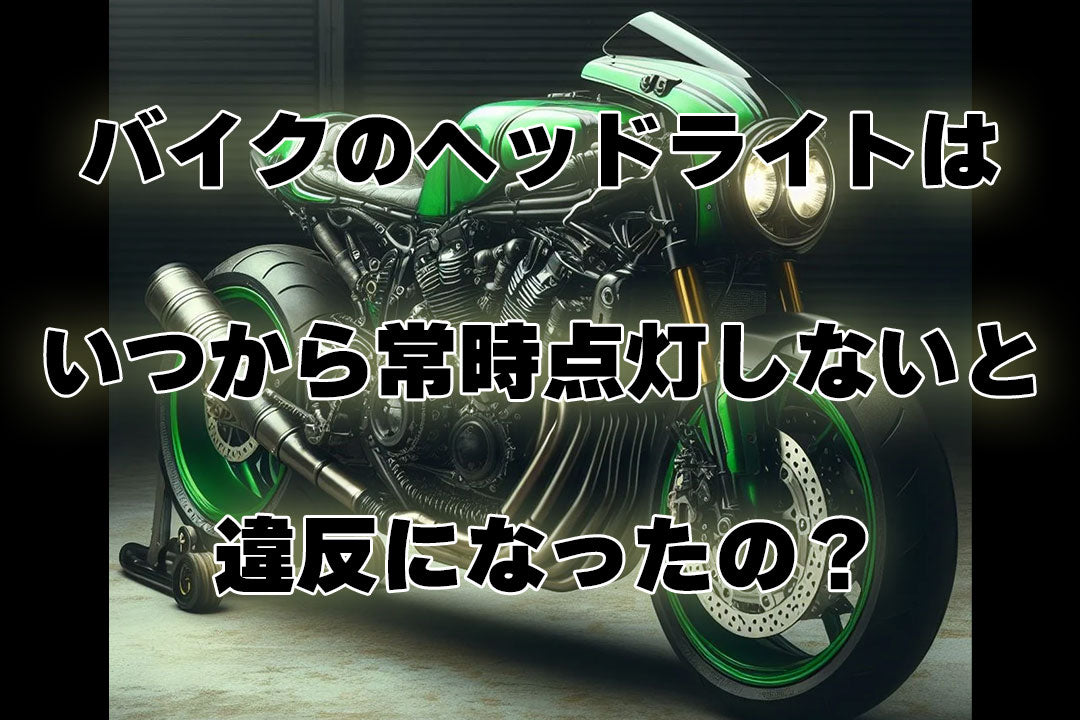
[Legal Background] When Did Motorcycle Headlights Become Required to Be On Continuously?

Source: https://pixabay.com/ja/photos/8B-3302899/
As of 2024, motorcycle headlights are required to be on continuously. This continuous illumination requirement began with the revision of the "Road Transport Vehicle Act," which came into effect on April 1, 1998 (Heisei 10). Motorcycles produced after this revision of the Road Transport Vehicle Act must have their headlights on continuously, and the ON/OFF switch for the headlights has been eliminated.
Why Was Continuous Headlight Illumination Made Mandatory?
The background for making continuous motorcycle headlight illumination mandatory was the high number of motorcycle accidents, especially the movement to reduce accidents between motorcycles and cars as much as possible. Motorcycles are smaller than cars, making it easy to misjudge their distance and speed. Continuous headlight illumination serves to make the motorcycle's presence more noticeable. To reduce motorcycle accidents, all motorcycles produced and sold after the enforcement of the "Revised Road Transport Vehicle Act" are required to have continuous headlight illumination.Is It a Violation if a Motorcycle Headlight Is Not On Continuously?

Source: https://pixabay.com/ja/photos/A4-2314904/
For motorcycles produced after the "Revised Road Transport Vehicle Act" came into effect on April 1, 1998 (Heisei 10), regardless of engine displacement, not having the headlights continuously illuminated is a violation and subject to police traffic enforcement. For motorcycles manufactured in 1998, the law applies to those produced on or after April 2, but there are some motorcycles that are exempt from continuous headlight illumination.
Older Models Produced Before the Law Revision Are Not in Violation
Motorcycles produced before April 1, 1998 (Heisei 10) are not in violation even if their headlights are not continuously illuminated. This is due to the principle of non-retroactivity in law, which states that one cannot be punished retroactively for actions committed before a law was enacted or revised. Therefore, motorcycles from the era before the Revised Road Transport Vehicle Act applied are exempt from the continuous headlight illumination requirement, and it is not a violation for them to have their headlights off during the day.It Is a Violation to Install an ON/OFF Switch on a Vehicle Produced After the Law Revision
Motorcycles produced on or after the day following the enforcement of the Revised Road Transport Vehicle Act (April 1, 1998) do not have ON/OFF switches for their headlights installed by the manufacturer. However, if you modify your motorcycle and install such a switch yourself, it will be a violation. Installing a headlight ON/OFF switch constitutes a violation of safety standards for defective lighting, etc., resulting in a fine of 5,000 yen for mopeds and 6,000 yen for motorcycles, plus 1 penalty point. Furthermore, the vehicle will fail its inspection, and if it is deemed illegally modified, you could face up to 6 months in prison or a fine of up to 300,000 yen. If convicted, a criminal record will be established by the court.Continuous Illumination Is Recommended for Safety and Traffic Rules
Continuous motorcycle headlight illumination is intended to make the motorcycle's presence known to surrounding traffic, and it is a rule designed with safety in mind. Installing a switch can lead to police enforcement and failing vehicle inspections, which can be inconvenient. Therefore, for the sake of making your presence known to others, it is safer to ride with your headlights continuously illuminated.Does Continuous Light Illumination Affect Battery Consumption?

Source: https://pixabay.com/ja/photos/A0-200601/
Many people might wonder if continuously running a motorcycle with its headlights ON, even during the day, puts a significant burden on the battery. We will explain "how continuous headlight illumination affects the battery."
Generally Designed to Be Problem-Free
Since the revised Road Traffic Act came into effect in 1998, continuous motorcycle headlight illumination has been mandatory, so motorcycle manufacturers design their bikes to operate without issues even with continuous headlight illumination. Battery drain rarely occurs when using standard lighting such as headlights, turn signals, and tail lights during normal riding, but caution is advised if you add heated gear, navigation systems, or other accessories. If you are drawing power from your motorcycle's battery for heated grips or heated clothing that warm you on cold days, make sure to inspect your battery regularly.Caution Is Required for Repeated Short Rides
Motorcycles store electricity generated during riding in the battery, but if you frequently take short rides of about 5 to 10 minutes (less than 10 km), the charging may not keep up. Continuous insufficient charging of the battery will accelerate battery wear and likely shorten its lifespan. If you usually only ride your motorcycle for short periods, try taking a slightly longer ride once a week to ensure the battery is fully charged.Regular Battery Status Checks Are Recommended
While battery drain is generally unlikely during normal riding, if you are concerned about your battery due to continuous headlight illumination, it is recommended to check your battery regularly. If you have a tester, you can determine the battery's condition from its voltage, so if you want to keep track of your battery's status, it's a good idea to have a tester. When measuring directly at the battery terminals, if the battery is normal, the voltage will be around 13V to 14V. If it drops below 12V, it indicates either insufficient charging or that the battery may be nearing the end of its life.There Are Some Models That Do Not Need Headlights On Continuously

Source: https://pixabay.com/ja/photos/88-3256896/
For motorcycles produced after April 1, 1998, when the revised Road Traffic Act came into effect, continuous headlight illumination is mandatory even during the day. However, a very small number of models are exempt from continuous headlight illumination. We will explain "what conditions a motorcycle must meet" to be exempt from continuous headlight illumination, and introduce specific model names and their overviews.
What Motorcycles Do Not Require Continuous Headlight Illumination?
As of September 2020, a law was enacted stating that motorcycles equipped with daytime running lights (DRL) do not need to have their headlights continuously illuminated. DRL, also known as daytime lights, are lights designed to improve visibility during the day. Conversely, simultaneously illuminating daytime lights and headlights is a violation. DRLs were common in Europe, but were not legally recognized in Japan. Passenger cars were approved in 2016, and motorcycles followed later in 2020.DRL-Equipped Vehicles Also Require Auto Lights
Motorcycles equipped with DRL (Daytime Running Lights) do not need to have their headlights continuously illuminated, but they must also have auto lights. Auto lights are a feature that automatically turns on the headlights when it gets dark. If the maximum luminous intensity of the daytime lights is 700 cd or less, manual switching is also acceptable. As long as the DRL and auto light requirements are met, even if these are not standard equipment on a particular model, retrofitting them can exempt the motorcycle from continuous headlight illumination.Two Motorcycle Models That Do Not Require Continuous Headlight Illumination
Models equipped with DRL and auto lights as standard, and thus not requiring continuous headlight illumination, include the HONDA "CRF1100L Africa Twin (from the 2021 model year)" and the HONDA "X-ADV (from the 2021 model year)." The CRF1100L Africa Twin is an adventure model based on an off-road platform, allowing for the attachment of many storage cases like panniers and top cases, making it suitable for long-distance touring. The X-ADV is a scooter-type adventure model, equipped with spoke wheels and inverted front forks, making it enjoyable both on and off-road. ■HONDA CRF1100L Africa Twin Specifications • Engine Type: Liquid-cooled, 4-stroke, inline 2-cylinder • Displacement: 1,082cc • Length x Width x Height (mm): 2,330×960×1,485 • Weight: 231kg • Maximum Output: 102ps • Maximum Torque: 112N・m • New Vehicle Price (incl. tax): 1,639,000 yen • Used Vehicle Market Price: Approximately 1.35 million to 1.85 million yen ■HONDA X-ADV Specifications • Engine Type: Liquid-cooled, 4-stroke, inline 2-cylinder • Displacement: 745cc • Length x Width x Height (mm): 2,200×940×1,340 • Weight: 236kg • Maximum Output: 58ps • Maximum Torque: 69N・m • New Vehicle Price (incl. tax): 1,320,000 yen • Used Vehicle Market Price: Approximately 850,000 to 1.35 million yenMore Compatible Models Expected in the Future
While the number of DRL-equipped motorcycles is increasing, particularly among European cars, in Japan, such models are currently limited mainly to some large motorcycles, with still few models adopting this feature. DRLs have less light output compared to headlights, which reduces the burden on the battery and is increasingly recognized as a measure against the environmental issues being discussed in recent years. More models will be exempt from continuous headlight illumination in the future, but if you wish to have DRLs on your beloved motorcycle, they can be installed as long as the headlights have an auto light function.Does Continuous Headlight Illumination Affect Other Vehicles at Night?

Source: https://pixabay.com/ja/illustrations/AF-8606516/
Occasionally, there are oncoming vehicles (mostly passenger cars) whose headlights are dazzling. Are the continuously illuminated headlights of motorcycles, which are mandatory, not dazzling to oncoming drivers? The reasons why headlights might be perceived as dazzling include the following factors:
Headlight Aim
If the headlight aim is not set to the prescribed direction, it will illuminate oncoming vehicles more than necessary, causing a dazzling sensation. The headlight aim can be adjusted, and it is inspected during vehicle inspections. However, motorcycles that do not require inspections have fewer opportunities for aim adjustment, so the headlights may remain misaligned. If you can see the faces of oncoming drivers unusually clearly, or if the headlight's illumination range extends further to the right than to the left, there is a possibility that the aim is off, so have it adjusted at a motorcycle shop.Headlight Brightness
If headlights are in high beam mode, they can dazzle oncoming drivers and pedestrians, obstructing their vision. Due to continuous headlight illumination, one might not realize that the high beams are on, and the light output can be dazzling even during the day. High beam is officially called "driving beam" and low beam is "passing beam." While driving with high beams at night is generally recommended, switch to low beam when there are oncoming vehicles or pedestrians, and use high and low beams appropriately.Pros and Cons of Continuous Headlight Illumination

Source: https://pixabay.com/ja/photos/8A-2683933/
Continuous headlight illumination has both advantages and disadvantages. We will also discuss countermeasures for the disadvantages, so please refer to them together.
Advantages of Continuous Headlight Illumination
The advantages of continuous headlight illumination include the following: • Makes your presence known to other traffic, such as oncoming vehicles. • Eliminates forgetting to turn on headlights. • Can signal your approach in areas with poor visibility. • Can signal your presence in bad weather. The biggest advantage is that it makes the motorcycle's presence known to cars and pedestrians, allowing them to notice it quickly, which has the effect of preventing traffic accidents. In areas with poor visibility, it can signal your approach to crossing traffic, and pedestrians are more likely to notice the motorcycle's presence. Another advantage is that you won't forget to turn on your headlights when it starts to get dark, eliminating unlit riding and avoiding police enforcement.Disadvantages of Continuous Headlight Illumination
The disadvantages of continuous headlight illumination are as follows: • Increased burden on the battery • Shorter headlight lifespan • Worsened fuel efficiency • May be mistaken for forgetting to turn off headlights Motorcycle manufacturers design bikes with continuous headlight illumination in mind, so battery drain rarely occurs during normal use. However, compared to not having continuous illumination, there is an increased burden on the battery, which shortens its lifespan. The lifespan of headlights is also shorter compared to only turning them on at night, but recently increasing LED headlights have a long lifespan, so this is less of an issue. Also, since electricity is generated by the generator linked to the crankshaft, an increase in power generation increases the load on the engine, leading to slightly worse fuel efficiency.Countermeasures for Disadvantages
The burden on the battery due to continuous headlight illumination can be reduced by "avoiding continuous short-distance driving," "not leaving the engine idling for long periods," and "periodically checking the voltage to monitor the battery's condition." A motorcycle's battery stores generated electricity, but if you frequently take short rides, the battery may not store enough electricity, leading to battery drain. To extend battery life, it's important to periodically check the battery and ensure the voltage is around 13V to 14V. If you frequently take short rides, make sure to take a long ride of 10km or more periodically to fully charge the battery.Summary

Source: https://pixabay.com/ja/photos/8B-8059754/
We have explained the background behind continuous motorcycle headlight illumination and what happens if it's violated. While still few in number, models that are exempt from continuous headlight illumination are now being sold, mainly among large motorcycles, and more compatible models are expected to be released in the future. Even for motorcycles with continuous headlight illumination, it is possible to be exempt from it if certain conditions are met. We have also explained how to do this, so if you are interested, please check it out.
Recommended Products
Latest Articles

Popular product


×
![]()