



Mar 30, 2026
[New Standards] Motorcycle Engine Displacement Categories: Maintenance Costs, Traffic Rules, and Licenses for Each Displacement
What does "cc" for a motorcycle mean? Motorcycle performance and maintenance costs that vary by cc.
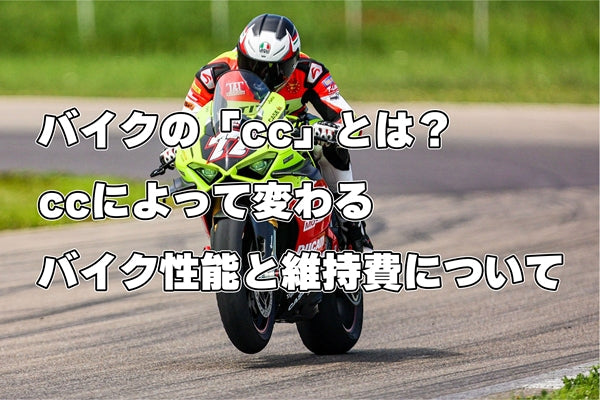
What does "cc" mean for motorcycles?

Source: https://pixabay.com/ja/photos/AF-7086569/
The term "cc" (cubic centimeter) for motorcycles refers to engine displacement.
cc indicates the size of the space (cylinder volume) within the engine's cylinder where the piston moves.
Engine displacement refers to the total volume of the cylinders used for combustion in the engine, indicating how much air-fuel mixture (fuel + air) can be drawn in and combusted in one cycle.
For example, a 250cc motorcycle means that the total cylinder volume of its combustion chambers is 250 cubic centimeters (cm³).
How do larger "cc" affect performance?
A larger engine displacement (cc) allows the engine to perform more combustion, which increases engine power (horsepower and torque), leading to improved acceleration and higher top speeds.
As displacement increases, the energy at high RPMs also increases, generating more torque, which allows for effortless riding on highways. However, since a larger amount of fuel is combusted at once, fuel efficiency is often lower compared to smaller displacement motorcycles.
In Japan, light vehicle tax and compulsory automobile liability insurance (Jibaiseki) rates are categorized by engine displacement, becoming more expensive as displacement increases. Additionally, larger engines result in increased vehicle weight, which can make handling more difficult.
Relationship between cc and motorcycle performance

Source: https://pixabay.com/ja/photos/82%A4-7721768/
Different cc levels result in variations in motorcycle performance, such as power and top speed, with larger displacements generally leading to higher performance.
Let's explore the relationship between cc and motorcycle performance, including power and top speed.
Impact of cc on various performance aspects
As a motorcycle's engine displacement (cc) increases, it can combust more fuel and air at once, leading to greater engine output (horsepower and torque).
Higher maximum output (ps or hp) results in higher top speeds and better performance at high speeds, while torque (N·m) affects acceleration, providing stronger performance from a standstill and on inclines.
The approximate maximum output (horsepower) and riding characteristics for different motorcycle displacements are as follows:
| Motorcycle Displacement | Approximate Max Output | Riding Characteristics |
| 125cc | Approx. 10-15 ps | Sufficient for city riding, but may feel underpowered with two riders |
| 250cc | Approx. 20-35 ps | May feel slightly underpowered on highways |
| 400cc | Approx. 40-50 ps | Comfortable for riding on highways and winding mountain roads |
| 1000cc | Approx. 150-200 ps | Very sharp acceleration, high performance comparable to a racing bike |
cc and Top Speed
As a motorcycle's engine displacement increases, the engine becomes more powerful, and the top speed also rises. The estimated top speeds for different displacements are as follows:
| Displacement | Estimated Top Speed |
| 50cc | Approx. 50-60 km/h (legal speed limit is 30 km/h) |
| 125cc | Approx. 90-110 km/h |
| 250cc | Approx. 130-160 km/h |
| 400cc | Approx. 160-180 km/h |
| 600cc | 200 km/h or more |
| 1000cc | 250 km/h or more (over 300 km/h for overseas models) |
Engine output affects top speed; even for motorcycles with the same displacement, those with higher maximum output tend to have higher top speeds.
Also, sport bikes with fairings tend to have higher top speeds than naked bikes, even with the same horsepower, because fairings help control airflow.
cc and Fuel Efficiency
As engine displacement increases, more fuel is combusted at once, leading to a tendency for fuel efficiency to worsen.
| Displacement | Estimated Fuel Economy | Characteristics |
| 125cc or less | Approx. 40-60 km/L | Excellent fuel economy, ideal for commuting and city riding |
| 250cc class | Approx. 30-40 km/L | Good balance of fuel economy and power |
| 400cc class | Approx. 20-30 km/L | For those who prioritize power over fuel economy |
| 1000cc or more | Approx. 10-20 km/L | High-output engine and large displacement result in poor fuel economy |
In terms of fuel efficiency alone, motorcycles 125cc or less can travel 40km to 60km per liter of gasoline, making them very economical.
While the 250cc class doesn't offer the same fuel efficiency as 125cc or less, it strikes a good balance between power and fuel economy, allowing for smooth riding.
Large displacement motorcycles see a significant drop in fuel efficiency when the throttle is opened wide, so careful throttle control and riding style are important.
cc and Vehicle Weight
Generally, as a motorcycle's engine displacement increases, the engine's weight also increases, and consequently, the overall vehicle weight tends to increase as well.
The estimated vehicle weight for each displacement is as follows. However, it's important to note that even for the same displacement, weight can vary depending on the motorcycle genre (naked, super sports, etc.), so these are just approximations.
| Displacement | Estimated Vehicle Weight |
| 50cc | Approx. 80-100kg |
| 125cc | Approx. 100-130kg |
| 250cc | Approx. 140-180kg |
| 400cc | Approx. 180-220kg |
| 600cc and above | 200kg or more (large models can exceed 250kg) |
Lighter motorcycles tend to have better fuel efficiency, so vehicle weight is also related to fuel performance.
Motorcycle classification by cc and required driving licenses

Source: https://pixabay.com/ja/photos/82-8109453/
Motorcycles are categorized by engine displacement, and you need to obtain a license that corresponds to the displacement of the motorcycle you wish to ride.
| Displacement | License Type | Minimum Age | Legal Speed Limit | Pillion Riding | Expressway |
| 50cc or less | Moped License | 16+ | 30km/h | Not allowed | Not allowed |
| 125cc or less | Small Motorcycle License (MT/AT) | 16+ | 60km/h | Allowed | Not allowed |
| 400cc or less | Standard Motorcycle License (MT/AT) | 16+ | 60km/h | Allowed | Allowed (for over 125cc) |
| No Limit (All motorcycles OK) | Large Motorcycle License (MT/AT) | 18+ | 60km/h | Allowed | Allowed (for over 125cc) |
| Up to 50cc (mopeds only) | Standard Car License (AT/MT) | 18+ | 30km/h | Not allowed | ✕ |
Motorcycle licenses up to 400cc (moped, small limited, standard motorcycle) can be obtained from age 16, but a large motorcycle license (no displacement limit) can be obtained from age 18.
To ride on expressways, a motorcycle with a displacement exceeding 125cc is required. Small limited licenses, which allow riding motorcycles up to 125cc, do not permit expressway riding.
Let's take a closer look at each displacement class.
1. 50cc or less (Class 1 Moped / Motorized Bicycle)
A Class 1 Moped license, allowing you to ride motorcycles 50cc or less, can be obtained from age 16. If you have a standard car license, you can also ride mopeds, such as the Honda Today, Yamaha Jog, or Super Cub 50.
The legal speed limit is 30 km/h, and a two-stage right turn is required on large main roads. Expressway riding and carrying a passenger are not allowed.
The advantages include very low maintenance costs like insurance, taxes, and fuel. However, the disadvantages are the 30 km/h speed limit, which means you cannot travel at the same speed as other traffic, and the requirement for two-stage right turns.
2. 51cc to 125cc (Class 2 Moped / Small Motorcycle)
Motorcycles 125cc or less require a small limited standard motorcycle license, obtainable from age 16. However, if you have a standard or large motorcycle license, you can also ride them, including models like the Honda PCX125 and Super Cub 110.
The maximum speed is 60 km/h, and a two-stage right turn is not required (treated the same as regular motorcycles). Pillion riding is allowed, but expressway riding is not.
The advantages are faster speeds than 50cc motorcycles, lower running costs (good fuel economy, low taxes and insurance), no two-stage right turn requirement, making it easier to flow with traffic. However, the disadvantages are that you cannot ride on expressways and need to obtain a small limited standard motorcycle license.
3. 126cc to 250cc (Light Motorcycle)
Motorcycles in the 126cc-250cc class are called light motorcycles. To operate them, you need a standard motorcycle license (MT/AT), obtainable from age 16, although a large motorcycle license also permits operation.
The legal speed limit is 60 km/h, and pillion riding and expressway travel are allowed. Examples include the Honda CBR250RR and Kawasaki Ninja 250.
The advantages include the ability to ride on expressways and lower maintenance costs due to not requiring vehicle inspections. The disadvantages are that it may feel underpowered compared to 400cc bikes, may lack stability on expressways, and can be fatiguing on long rides.
4. 251cc to 400cc (Small Motorcycle / Standard Motorcycle)
The 251cc to 400cc class is known as the small motorcycle (standard motorcycle) class. To operate these, a standard motorcycle license (MT/AT) is required, obtainable from age 16 (a large motorcycle license also permits operation).
The legal maximum speed is 60 km/h, and both two-person riding and expressway travel are allowed. Examples include the Honda CB400SF, Kawasaki Ninja 400, and Yamaha MT-03.
The advantages are more power than 250cc bikes, making highway cruising comfortable, and relatively easy handling. The disadvantages are that vehicle inspections are required (every 2 years), leading to higher fuel consumption and maintenance costs compared to 250cc bikes.
5. 401cc and above (Large Motorcycle)
The 401cc and above class are large motorcycles, requiring a large motorcycle license (MT/AT).
This is the only motorcycle license that can be obtained from age 18 or older.
You can ride all motorcycles regardless of displacement, such as the Honda CBR1300SF and Harley-Davidson Street Bob. The legal top speed is 60 km/h, and both pillion riding and expressway travel are allowed.
The advantages are overwhelming power for comfortable acceleration and highway cruising, making them suitable for long-distance touring and sport riding. The disadvantages are high maintenance costs (vehicle inspections, poor fuel economy, expensive tire and oil changes), difficult handling, and a high barrier for beginners.
Motorcycle maintenance costs by cc

Source: https://pixabay.com/ja/photos/AF-6798914/
Motorcycles incur various maintenance costs such as taxes and fuel expenses, and these annual costs tend to increase with larger engine displacements.
Let's examine the types of maintenance costs for motorcycles, including costs by displacement (class) and total annual maintenance expenses.
Total Annual Maintenance Costs
Motorcycle maintenance costs vary by engine displacement, and the estimated total annual costs are as follows:
| Displacement | Light Vehicle Tax (Annual) | Compulsory Insurance (Annual) | Voluntary Insurance (Estimate) | Fuel Economy (km/L) | Maintenance | Vehicle Inspection (Every 2 years) | Annual Total (Estimate) |
| 50cc | 2,000 yen | Approx. 4,000 yen | Approx. 30,000 yen | 50-60km/L | 10,000-30,000 yen | None | Approx. 60,000-80,000 yen |
| 125cc | 2,400 yen | Approx. 4,000 yen | Approx. 35,000 yen | 40-50km/L | 20,000-30,000 yen | None | Approx. 70,000-100,000 yen |
| 250cc | 3,600 yen | Approx. 6,500 yen | Approx. 45,000 yen | 30-40km/L | 30,000-50,000 yen | None | Approx. 100,000-150,000 yen |
| 400cc | 6,000 yen | Approx. 8,500 yen | Approx. 50,000 yen | 20-30km/L | 40,000-60,000 yen | Approx. 50,000-70,000 yen | Approx. 200,000-250,000 yen |
| 600cc and above | 6,000 yen | Approx. 8,500 yen | Approx. 70,000 yen | 10-25km/L | 60,000-100,000 yen | Approx. 50,000-70,000 yen | Approx. 250,000-350,000 yen |
Especially for motorcycles over 250cc, vehicle inspections are required every two years (the first inspection is after three years for new bikes, then every two years thereafter), which adds to the annual maintenance costs (vehicle inspection costs are added by dividing by two years).
Motorcycles up to the 250cc class do not require vehicle inspections, which keeps their maintenance costs lower, making them a cost-effective class.
Automobile Tax
Automobile tax (light vehicle tax for motorcycles) is a tax that must be paid annually by individuals who own a motorcycle as of April 1st each year.
| Displacement | Light Vehicle Tax (Annual) |
| 50cc or less | 2,000 yen |
| 51cc to 90cc | 2,000 yen |
| 91cc to 125cc | 2,400 yen |
| 126cc to 250cc | 3,600 yen |
| 251cc to 400cc | 6,000 yen |
| 401cc and above | 6,000 yen |
Up to 125cc, the tax is relatively inexpensive, around 2,000 yen. For mid-sized motorcycles from 126cc to 400cc, it's slightly higher at 3,600 yen.
Although there isn't a significant difference as displacement increases, the annual payment obligation means the cumulative difference over a long period of motorcycle ownership can be substantial.
Compulsory Automobile Liability Insurance (Mandatory by Law)
Compulsory Automobile Liability Insurance (Jibaiseki) is an insurance that pays out when someone is killed or injured in a traffic accident. It is mandated by law (failure to enroll carries penalties).
| Displacement | 1 Year | 2 Years | 3 Years | 4 Years | 5 Years |
| 50cc | 6,910 yen | 8,560 yen | 10,170 yen | 11,760 yen | 13,310 yen |
| 125cc | 7,310 yen | 9,270 yen | 11,130 yen | 12,950 yen | 14,690 yen |
| 250cc | 8,650 yen | 12,220 yen | 15,720 yen | 19,140 yen | 22,510 yen |
| 400cc and above | 8,650 yen | 12,220 yen | 15,720 yen | 19,140 yen | 22,510 yen |
Compulsory automobile liability insurance is relatively inexpensive for 50cc and 125cc classes, and higher for 250cc and above. However, for all classes, paying for multiple years upfront makes the annual premium more affordable.
For motorcycles requiring vehicle inspections, joining is usually done during the inspection, so payment is rarely forgotten. However, for the 250cc and below classes, which don't require inspections, it's important to remember to pay.
Voluntary Insurance (Insurance to enhance accident coverage)
Voluntary insurance, unlike compulsory insurance, is not mandatory but is taken out by most riders to cover damages in case of an accident.
It covers damages not fully covered by compulsory insurance, and you can choose the scope and content of coverage yourself, including personal injury, property damage, and passenger coverage.
| Displacement | Annual Premium (Estimate) |
| 50cc | Approx. 20,000-30,000 yen |
| 125cc | Approx. 30,000-40,000 yen |
| 250cc | Approx. 40,000-50,000 yen |
| 400cc | Approx. 50,000-70,000 yen |
| 600cc and above | 70,000 yen or more |
Voluntary insurance premiums are lower for smaller displacement motorcycles, but they increase for larger bikes. Also, premiums are lower for riders in their 40s compared to those in their 20s.
In the event of an accident resulting in death, injury, or permanent disability to another party, compensation claims can amount to tens of millions or even hundreds of millions of yen. Therefore, this insurance is relatively inexpensive compared to the potential payout.
Fuel Economy and Gasoline Costs
As engine displacement increases, fuel efficiency tends to worsen, leading to higher gasoline costs and, consequently, higher maintenance costs and expenses for long-distance touring.
| Displacement | Fuel Economy (km/L) | Gasoline Cost for 500km Travel (170 yen/L) |
| 50cc | 50-60km/L | Approx. 1,500 yen |
| 125cc | 40-50km/L | Approx. 2,000 yen |
| 250cc | 30-40km/L | Approx. 2,500-3,000 yen |
| 400cc | 20-30km/L | Approx. 3,500-4,500 yen |
| 600cc and above | 10-25km/L | 5,000 yen or more |
The 50cc to 125cc class boasts excellent fuel economy, capable of traveling 40km to 60km per liter of gasoline (according to catalog data), making them very cost-effective.
The 250cc class offers a good balance of fuel economy, performance, and usability, capable of traveling 30km to 40km per liter of gasoline. Since it doesn't require vehicle inspections, its annual maintenance costs are also relatively low.
Recommended Products
Latest Articles

Popular product


×
![]()